
Double trouble: Competitive alkylation and LCMS analysis for efficient screening of dual payload ADCs


Dual payload antibody drug conjugates (ADCs) can be a successful strategy to overcome acquired tumour resistance to monotherapies. Different modes of action and differing distribution of released payload can prove synergistic in increasing the therapeutic window. One of the first examples of this approach combined the positive attributes of both MMAE and MMAF and turned their negative attributes into positives; in an antigen heterogeneous cancer model with upregulation of efflux pumps, a dual payload ADC released both MMAE and MMAF inside the cell. The former being rapidly exported into the tumour microenvironment, where it exerted a bystander effect killing antigen negative cells and the latter, being charged, evading the efflux pump providing effective cell kill of the antigen positive cells. Neither single agent was effective in this challenging model1 2 .
With multiple payloads, however, comes increasing analytical complexity. Average DAR analysis becomes exponentially complex with an increasing number of different conjugated species. The DAR for MMAE and MMAF ADCs can be determined by hydrophobic interaction chromatography (HIC) based on the increasing hydrophobicity of more highly conjugated species. This is rendered difficult in a multi-drug ADC with multiple, overlapping species that all require resolution. Here, we show how mass spectrometry analysis allows peak identification and DAR quantification of a dual-payload stochastic ADC where HIC chromatography is not capable.
Briefly, Trastuzumab was partially reduced with TCEP, the pool split and competitively alkylated with varying ratios of MC-Val-Cit-PAB-MMAE (1316.6 Da) and MC-Val-Cit-PAB-MMAF (1330.6 Da) to produce mixed pools of conjugates. HIC analysis was performed natively on a Butyl column (2.5 µm, 35 x 4.6mm) on an 18-minute gradient of 1.5M ammonium sulphate, 25mM NaPi, pH 6.95 and 25mM NaPi, pH 6.95 + 25 % IPA. LCMS analysis was performed under reducing conditions on a SCIEX X500B mass spectrometer. The chromatography was performed with a C8 column (3.6 µm, 50 x 2.1 mm) on a five-minute gradient of water and acetonitrile both with 0.1% formic acid.
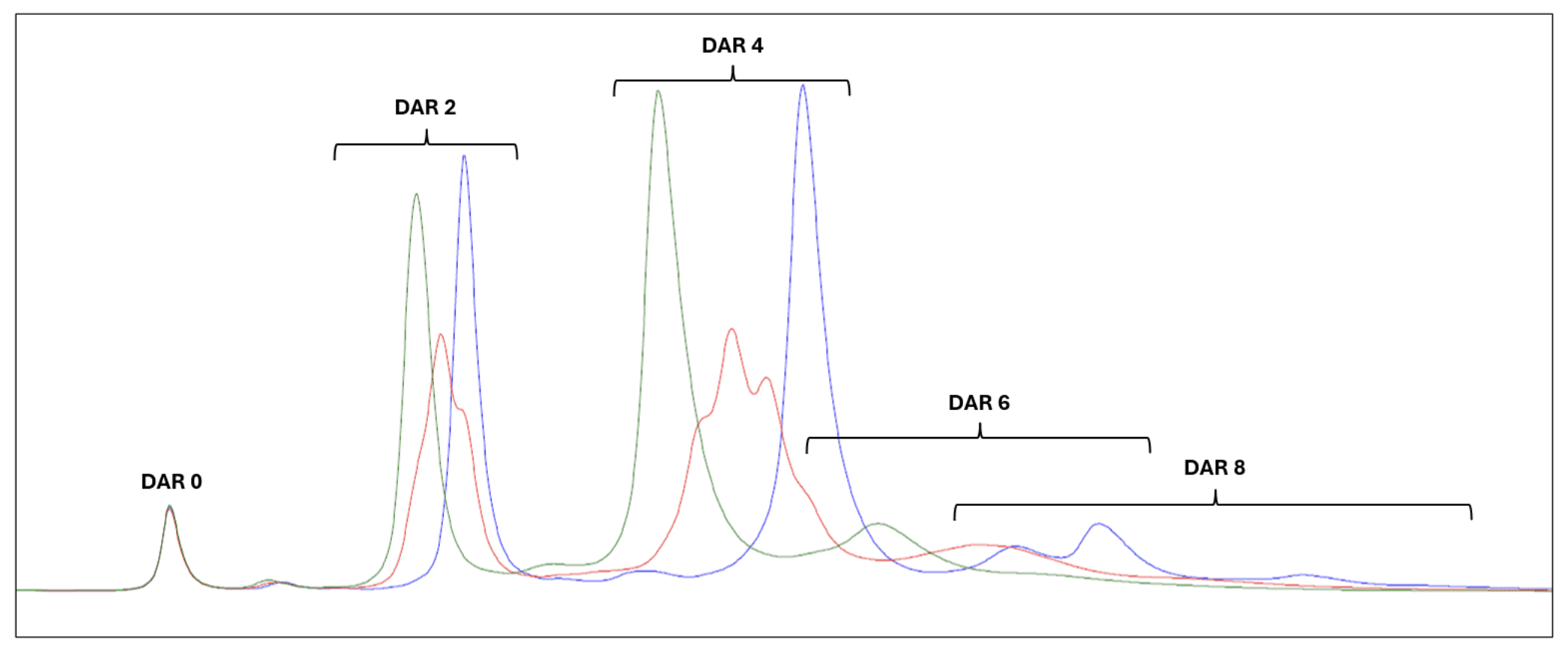
Figure 1. HIC analysis of T-MMAE (blue), T-MMAF (green) and T-MMAE+F (red)
The DAR was determined for both T-MMAE and T-MMAF by HIC. However, the dual payload variant has overlapped and split peaks, which hindered DAR quantification (Figure 1).
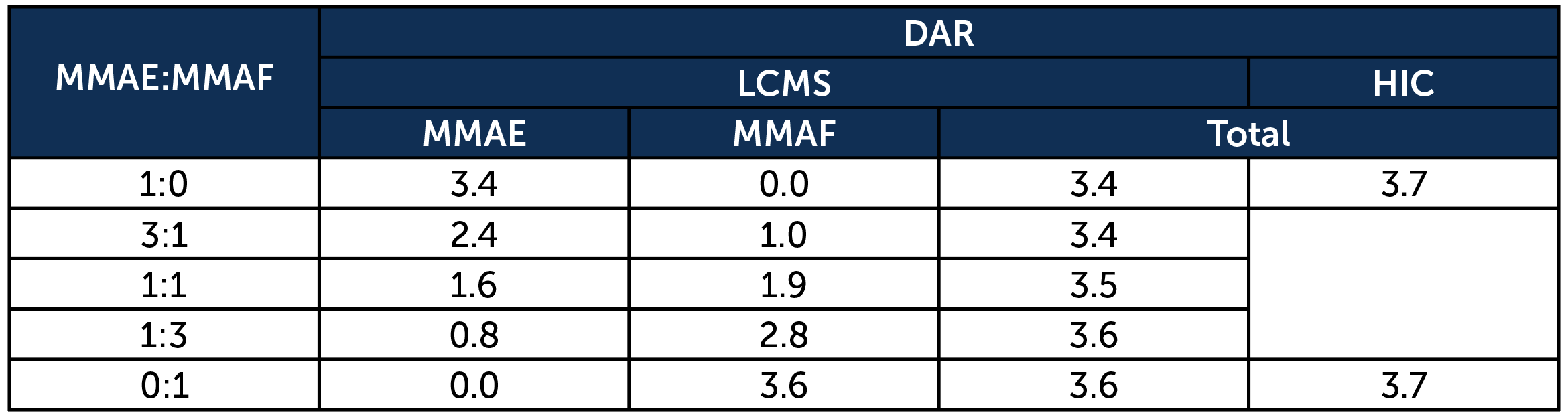
Table 1. DAR calculations by LCMS and HIC.
When analysed by reducing LCMS, average DARs for the dual payload ADCs were quantified following reconstruction of the mass spectrums (Table 1, Figure 2). Heavy chain species showed some overlap between the various species due to the similar molecular weights of the conjugated toxins. The average DAR assigned by HIC for the single payload ADCs were within 10% relative percentage difference (RPD) of the LCMS values. We note that the lower average DAR measurements by LCMS vs HIC are likely to be due to incomplete ionisation of higher DAR species which optimisation on a per payload basis would compensate for. LCMS analysis of dual-payload ADCs overcomes the limitations of traditional DAR determination methods for next-generation conjugates.

Figure 2. LCMS reconstruction overlay of H1 and H2 T-MMAE (blue), T-MMAF (green) and T-MMAE+F (red)
Dual payload ADCs are increasingly represented in the preclinical space and competitive alkylation, combined with mass spectrometry allows rapid screening of different linker-payloads and DAR ratios using off-the-shelf reagents avoiding costly and time-consuming protein and/or linker engineering.