
At Sterling we can support your ADC linker payload synthesis through early preclinical to GMP clinical and commercial manufacture; developing processes with full method development testing and release.

15+ years of experience with HPAPI development and manufacturing
cGMP HPAPI suites with <0.001μg/m3 containment
Linker payload batches from gramme to kg scale
Fully contained production scale low pressure and high pressure chromatography
Fully contained GMP lyophilisation (30L at -85°C)
Dedicated HPAPI process development lab
We are equipped to support a range of project requirements for these complex molecules, including cGMP purification and lyophilisation.
Linker payload design and proof of concept
We can support linker payload design using both a literature precedented approach and internal experience to find the optimal way to attach your payload to the right linker. We understand that at this early stage, customers are looking to fail fast to find their lead drug conjugate quickly, with the optimal linker and payload. We can provide rapid synthesis of milligram scale quantities of bespoke linker payloads for proof of concept conjugation work. We have experience across a broad range of drug conjugates including antibody drug conjugates (ADCs), protein degraders, peptide and polymer drug conjugates.
Linker payload development
We can support both process and analytical development of your linker payload and linker payload intermediates from milligram scale to grams. At Sterling, we have development capabilities ranging from route scouting and design, through to process optimisation and full validation support, including quality by design and design of experiments.
Our fully equipped process development labs allow us to handle ultra high potency payloads with containment down to <0.001μg/m3, with fully contained weighing, dispensing, reaction, work-up, isolation and drying. We have a range of linker payload purification options including automated flash chromatography and prep HPLC, and lyophilisation.
Once development is complete, we have the ability to seamlessly transfer your project to GMP manufacturing.
Linker payload manufacture
Our team can provide linker payload cGMP manufacture from <100g to 10kg scale.
- Isolator containment validated to OEL <0.001μg/m3 (surrogate testing demonstrated)
- Gowning and de-gowning
- Multilayer facility controls with pressure cascades and downflow booth migration control
- Dedicated utilities
- Weigh/dispense/dissolve
- Integrated solution charge to current process capabilities
- Contained packaging
- Small-scale single-use production capabilities within
- Normal and reverse phase chromatography with high (up to 100 bar) and low pressure systems with integrated PAT
- Fully contained GMP lyophilisation (30L at -85°C)
Linker payloads and safety
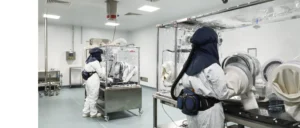
Highly potent API manufacturing requires stringent safety standards as well as specialised facilities and equipment. Our Wisconsin, US site is equipped with two high containment cGMP manufacturing suites that are purpose-built for the safe handling of HPAPIs. These suites are FDA approved and capable of handling HPAPI batches up to 10 kilograms while adhering to regulatory requirements around the world.
Looking for a partner to support your linker payload requirements?
Linker payload FAQs
The linker payload is one of the most important parts of an antibody drug conjugate (ADC).
The linker payload is conjugated to the targeting antibody, and once inside the tumour cell or within the tumour microenvironment, the linker is cleaved or degraded to release the cell killing payload.
Good linker payload design is crucial to ADC performance. Choosing the right linker can prevent premature payload release and systemic toxicity, increase hydrophilicity, bystander effect and determine the potency of the ADC.
There are two different types of ADC linker. The majority of approved ADCs contain cleavable linkers which are designed to be cleaved the cell cytoplasm by enzymes such as protease or glucuronidase. These allow linker cleavage and elimination back to the original payload which is the active metabolite.
Non-cleavable linkers will release their payload in the target cell after complete lysomal degradation of the ADC, the linker remains part of the active metabolite, staying attached to the payload
A regular ADC will have one payload type conjugated to the antibody. A dual payload ADC contains two different payloads – designed to work on two different biological pathways. The two payloads can be connected to the antibody through a branched linker or using different conjugation chemistries. The combined action of a dual linker payload can give higher efficacy and overcome payload resistance
A range of different payloads have been used to make ADCs. Historically cancer dugs that were too potent to use as stand alone treatments were conjugated to antibodies. As the science has evolved so have the type of payloads used. Recently ther has been a trend towards less potent payloads and higher DARs, also non traditional payloads such as degraders, oligonucleotides and cytokines.
In general payloads should have the ability to kill tumour cells over healthy cells, have good physiochemical attributes, such as good hydrophilic/phobic balance and also be stable in circulation. Cell permeability is also important, depending on whether you want the released payload to stay in the cell or diffuse out to neighbouring cells (bystander effect).
From a chemistry consideration its good to have a payload that is easy to synthesise, scalable and contains an obvious point reactive group that can be used as a point of attachment to the linker – such as an amine or alcohol.
Most payloads used in ADCs are highly potent molecules and are therefore very cytotoxic at low doses. Containment is needed to protect those developing and manufacturing the linker payloads, as well as to avoid cross contamination and ensure compliance with regulations.
Linker payloads are often very large and complex molecules with a mix of polarity and charge, which can give rise to significant purification challenges. Unlike with small molecules, crystallisation isn’t usually an option. Both normal phase and reverse phase chromatography are often used, with lyophilisation and solid phase extraction techniques employed to address large volumes of polar solvents.
ADCs need to be stable in circulation but ableto release payloads within the tumour cell or tumour microenvironment. Premature payload or linker payload release can cause systemic toxicity and reduce the therapeutic index of the ADC. Careful design of the linker can help control when the payload is released and the hydrophilicity of the molecule, which in turn can enhance the pharmacokinetics and reduce off target toxicity.

Related Pages

ADC Clinical Manufacturing


