

Overview:
- Potency challenges: Compound classified as highly potent (<1 µg/m³ OEL)
- Process optimization: Redesigned route achieved higher overall yields of 5% to 38% and eliminated chromatography-based purification steps
- Containment excellence: Utilization of high potency development center (HPDC) and ONFAB isolator for nanogram-level safety
- Regulatory readiness: Cleaning and validation protocols verified by analytical testing
- Customer impact: Successful delivery under tight timelines with superior safety and quality outcomes
Background:
A US-based biotechnology company engaged with Sterling to develop and optimize their medicinal chemistry route for non-GMP manufacturing. The customer selected Sterling for its proven track record and reputation as a reliable partner in preclinical to commercial drug substance development.
With over 50 years of experience, Sterling provides comprehensive support across the drug development lifecycle and employs data-driven Occupational Exposure Limit (OEL) assessments to manage the handling of compounds with unknown or high toxicity.
Challenges:
Part A: The initial route was typical of discovery-phase processes. It delivered low overall yields (5-8%) over five steps and required chromatographic isolation during the final, highly potent stage. Such an approach was unsuitable for scale-up due to inefficiencies, safety risks, and impractical purification requirements. To advance the compound toward preclinical and potential commercial production, the Sterling team needed to redesign the synthetic route for higher yields, improved safety, and elimination of chromatography-based purification steps.
Part B: During toxicological evaluation, the development team, working alongside our in-house board-certified toxicologist, determined that the compound exhibited high potency, with an OEL in the range of 0.01-1µg/m³. This classification required enhanced containment strategies, specialized facility design, and rigorous handling procedures to ensure both operator safety and product integrity.
The Sterling Solution:
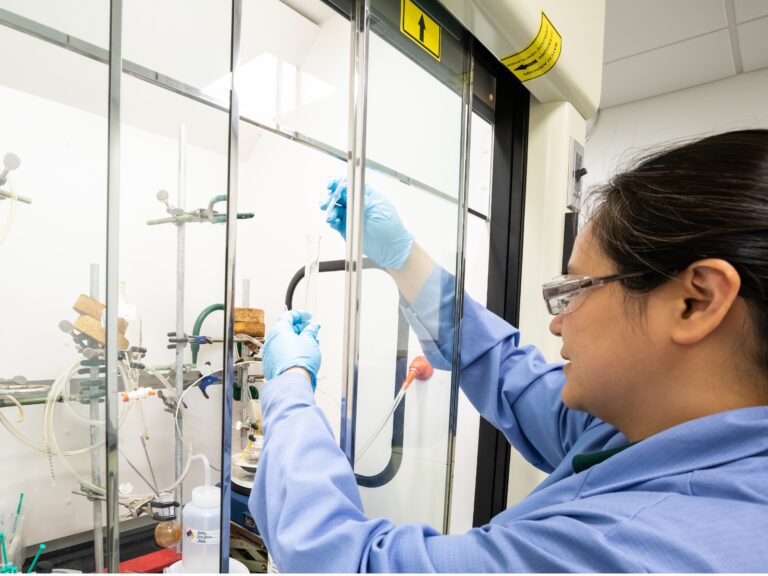
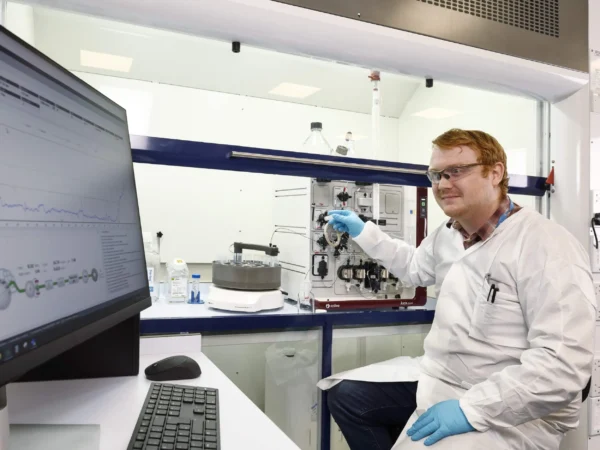
Sterling redesigned the entire route and confined the HPAPI generation to the final step, maximizing containment, yield, efficiency, and scalability. Moreover, a cross-functional high potency team, comprising of Sterling’s experts in process chemistry, toxicology, and containment engineering, collaborated closely with the customer to establish a safe and efficient development path, including integrated toxicological assessment, definition of containment and handling strategies, and development of a scalable process suitable for controlled HPAPI manufacturing. The initial manufacture and isolation of the HPAPI were conducted within a dedicated suite at Sterling’s Wisconsin, US facility. This is a controlled-access environment featuring barrier isolators, airlocks, and cascading air differentials, capable of handling compound with OELs <0.001 ug/m3. To further enhance containment and operational efficiency, established high-containment handling practices were applied within the existing barrier isolation system. These measures enabled secure transfer and sampling of materials within the production environment while minimizing operator exposure and reducing the risk of cross-contamination, thereby supporting safe and reliable HPAPI manufacturing operations.
However, given the smaller quantities of API required (500g of non-GMP HPAPI), Sterling conducted the bulk manufacturing at its North Carolina facility, utilizing an ONFAB single-use flexible isolator.
This isolator, designed for OEB 5-6 containment, provides protection for materials with nanogram-level exposure limits. Operating under negative pressure with HEPA-filtered airflows, the ONFAB systems ensured full environmental containment, even during pressure fluctuations or process transitions.
Working with highly potent materials demands rigorous attention to cleaning validation and work flow optimization. Sterling developed and implemented enhanced cleaning procedures, supported by validated analytical methods for surface residue testing. Analytical verification confirmed the effectiveness of these procedures in removing trace levels of the HPAPI from work surfaces and equipment, ensuring compliance with stringent safety and quality standards.
Step 1: One pot reductive decarboxylation
Maximum conversion was achieved when a solution of TFA in 2-MeTHF was added slowly over NLT 4h, yield increased from 50% to 91%.
Steps 2 and 3: α,β – oxidation/formylation (via Duff reaction)
The customer’s initial process produced dimeric impurities predominantly. The process involved formylation with ethyl formate and telescoping to the next stage under oxidative conditions with MnO2. By changing the reaction type and sequence of the reagents addition, yield improved from 30% to 72% over two steps, without any major impurities. HPLC purity for each isolated intermediate was >98%.
This ethylene glycol intermediate was furnished via SNAr in 90% yield. ¹H and 19F NMR conformed to structure. The customer’s initial process involved Buchwald-Hartwig etherification between the chloro analog (as substrate) and THP-protected ethylene glycol, using Pd(dba)2 and tBuBrettPhos as a catalyst and ligand, respectively.
Maximum conversion (84%) was only achieved using a catalyst and ligand from a specific vendor, presenting a major limitation to scale up. This condition usually generates other impurities, and after workup, the THP-protected intermediate was isolated in ≤57% yield with 98% purity. Along with the product, were 0.5% of the starting chloro substrate and 1.5% of its corresponding deschloro impurity.
Step 5: HPAPI formulation via reductive amination
In addition to the product, a saturated aldehyde impurity and other minor impurities were generated in the reaction. The customer solely utilized column purification for product isolation and yield was less than 55%. 1N NaHSO3 (aq.) washes were implemented during workup to remove the saturated aldehyde impurity. Moreover, several solvents and solvent combinations were screened to replace the chromatographic purification. Toluene crystallization, followed by MEK trituration was developed to purge the other impurities, and the desired polymorph was isolated in 65% yield on a 650g scale, with greater than 99% area chiral purity and >95% potency. All solvents and metals were below ICH limits.
Outcomes:
Sterling successfully delivered the HPAPI safely, efficiently, and within a highly constrained project timeline, exceeding the customer’s expectations for yield, quality, and safety compliance.
Throughout the project, Sterling maintained transparent communication with the customer, providing regular updates on safety protocols, process modifications, and contamination control strategies. The success of this collaboration not only demonstrates Sterling’s technical expertise and operational flexibility but also reaffirms its position as a trusted partner for the development and manufacture of high and ultra-high potency APIs.