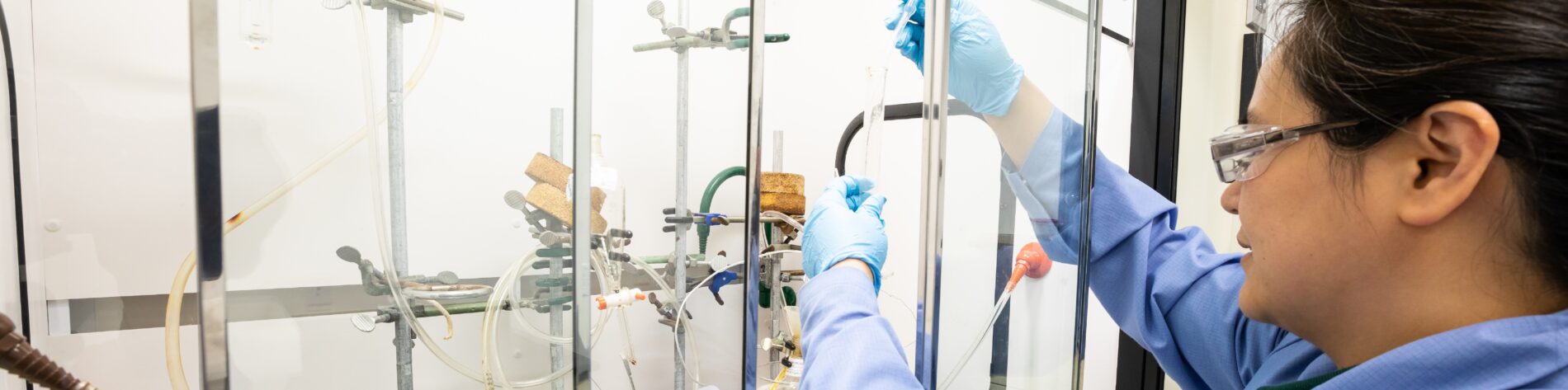
As a CDMO with 50+ years’ experience in API development and manufacturing, we possess the synthetic and organic chemistry expertise to support our customers with bespoke GMP and non-GMP radiolabelling solutions.
Fast facts

GMP and non-GMP 14C radiolabelling and 3H tritium labelling
Capacity up to 100L
Approved to handle controlled substances Schedules 1-5
Full GMP Certificate of Analysis (CofA)
Our radiolabelling technique
Our analytical and chemistry teams work in close collaboration to develop a radiolabelling technique that is bespoke to each customer project.
Our method focuses on the testing and analysis of the unlabelled API, which allows our customers access to a wider range of testing equipment; attaching the labelled compound later in the process to maximise the yield of the final labelled API. This approach provides our customers with several efficiencies, including time and cost, and mitigates against the risk of knowledge gaps during transfer, as a result of utilising one single source and a dedicated team to work on the project throughout its lifecycle.
- Custom GMP and non-GMP 14C radiolabelling and 3H tritium labelling for:
- Small molecules
- Volatile compounds
- Aromatics and heterocycles
- Nucleotides and oligonucleotides
- Peptides (amino acids)
- Chiral
- Salt formation
- Integration of either 14C or 3H into the molecular structure
- Synthesis of stable labelled compounds including antibody drug conjugates (ADCs), 2H and 13C
- Labelled metabolites and reference materials
- Quality control and analytical support
- Bioburden analysis and testing, where appropriate
- Solid state and microbiological analysis, including polymorph control, particle size distribution (PSD)/reduction, and polymer dispersion
- Column purification (purity or chirality)
- Stability studies and storage options
- HPLCs with radioflow, with options for UV or diode array detection (DAD)
- Scintillation
- Providing total activity (TA) results (Ci)
- Nuclear magnetic resonance (NMR)
- Structural confirmation/identity
- Liquid chromatography–mass spectrometry (LC-MS)
- Structural confirmation/identity
- Gas chromatography (GC)
- Ultra-high performance liquid chromatography (UPLC) with mass spectrometry (MS)
- Inductively coupled plasma mass spectrometry (ICP-MS)
- Fourier transform infrared (FT-IR) spectroscopy
- Differential scanning calorimetry (DSC)
- Thermogravimetric analysis (TGA)
- Karl Fischer equipment (CKF, VKF, Stromboli)
- Lyophilisation
- Refrigerators and freezers at temperatures including 2-8°C, -20°C and -80°C
- Variety of analytical balances
- X-ray powder diffraction (XRPD)
- <1mg/m3 containment isolator


